
 Ελληνικά
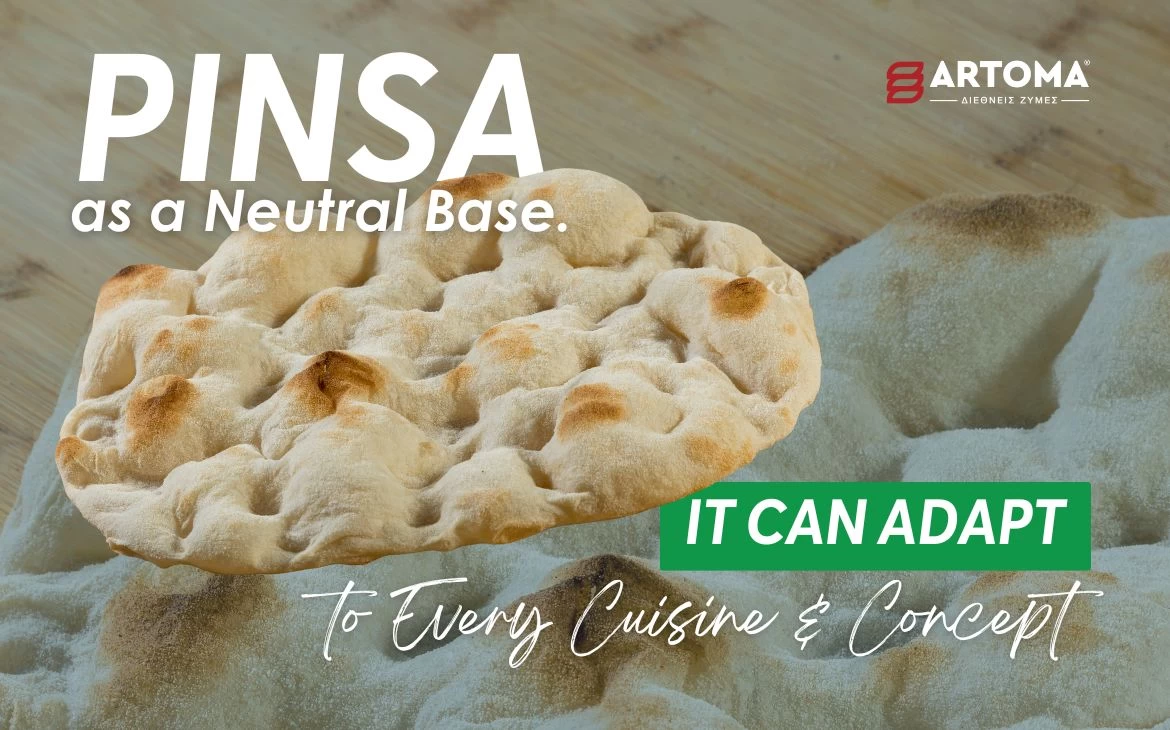
In modern food service, the success of a product is not defined only by taste. It is defined by how easily it can adapt to different concepts, ingredients and serving styles. This is exactly where the real strength of pinsa lies.
Pinsa does not function as a finished dish. It functions as a base. And this base can support thousands of different ideas, without limiting the creativity of the kitchen.
Not another “ready-made option”, but a canvas
Unlike products that come with a predefined character, pinsa does not impose a specific direction. It does not “signal” a single cuisine, it is not limited to one culinary style, and it does not require a specific identity.
This makes it ideal for:
- Greek cuisine,
- Mediterranean approaches,
- international concepts,
- fusion menus,
- both premium and casual environments.
Pinsa works much like good bread or a high-quality dough. It adapts to the ingredients and the philosophy of the kitchen.
One base, different expressions
The same product can be expressed in completely different ways depending on the concept. In an all-day environment, pinsa can support lighter, well-balanced options. In a wine bar, it can act as a base for more intense flavour combinations. In hotel or catering settings, it offers consistency and ease of adaptation.
What matters is not what “should” go on top of pinsa. What matters is that it can support everything, without losing its character.
Pinsa as a tool for creativity
For a professional kitchen, pinsa offers freedom. It does not lock creativity into specific patterns. It can follow seasonality, local ingredients, distinctive concepts or themed menus.
This flexibility allows professionals to:
- refresh the menu without changing the base,
- adapt easily to different times of day,
- make use of ingredients already available in the kitchen.
Pinsa does not require building a new concept around it. It integrates naturally into what already exists.
From casual to fine dining environments
One of the most common misconceptions is that pinsa fits only a specific level of dining. In practice, it can stand with equal confidence in both casual and more demanding environments.
The difference is not in the base itself, but in presentation, ingredient quality and overall menu philosophy. This is exactly what makes pinsa so adaptable.
Consistency without limitation
For professionals, pinsa offers another key advantage: consistent results without restricting expression.
The base remains reliable. Creativity evolves. This allows for:
- better control in the kitchen,
- fewer errors,
- greater confidence during service.
When the base is stable, creativity is free to expand.
Why it does not exclude any cuisine
Pinsa does not require specialization in a specific cuisine. It does not demand a change of identity. It does not conflict with existing dishes.
Instead, it:
- works as a complementary element,
- adapts to the ingredients of each kitchen,
- follows the philosophy of the concept, not the other way around.
This is why it can be integrated into any menu, regardless of style, country or culinary direction.
Pinsa as a base for evolution
In a menu that aims to evolve, pinsa acts as a stable point of reference. It can support new ideas, seasonal changes and experimentation without risk.
It is not simply an option. It is a creative platform.
The strength of pinsa lies not in what it is, but in what it allows to be created. As a neutral, high-quality base, it opens space for expression, adaptation and evolution.
That is why it does not exclude any cuisine.
It accommodates them all.